
'To achieve a corpus of Rs 10 crores in the coming years, I would suggest you increase your SIP, advises Nikunj Saraf, vice president, Choice Wealth.
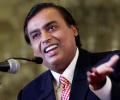
The strong correlation between its sales (revenue or turnover) and crude oil prices (average for the financial year) suggests that Ambani may be proved right.

HCL Tech was the top gainer in the Sensex pack, rising over 4 per cent, followed by TCS, Bajaj Finserv, Nestle India, Bharti Airtel, Bajaj Finance and Tech Mahindra. NSE Nifty advanced 45.95 points to 16,496.45.

Reliance Industries was the top gainer in the Sensex pack, soaring over 4 per cent, followed by Titan, Tata Steel, Bajaj Auto, Maruti and Dr Reddy's. Nifty advanced 89.45 points to its all-time closing peak of 17,323.60.

Benchmark equity indices Sensex and Nifty on Tuesday spurted by over 2.5 per cent to log their best single-day gains in three months, propelled by heavy buying in metal, energy and banking stocks amid a global rally in stocks. The 30-share BSE benchmark zoomed 1,344.63 points or 2.54 per cent to settle at 54,318.47 points with all of its constituents closing with gains. During the day, it jumped 1,425.58 points or 2.69 per cent to 54,399.42. The broader NSE Nifty rallied 417 points or 2.63 per cent to finish at 16,259.30 points.
Among the Sensex firms, HCL Technologies fell the most by 2.4 per cent. IndusInd Bank (2.35 per cent), Infosys (2.28 per cent), Wipro (1.8 per cent), NTPC (1.71 per cent), Asian Paints (1.7 per cent), Tata Consultancy Services (1.36 per cent),Tech Mahindra (1.03 per cent) and SBI (1 per cent) were among the major laggards.

HCL Tech was the top gainer in the Sensex pack, rising over 2 per cent, followed by Infosys, Reliance Industries, Tech Mahindra, Bajaj Auto and M&M. On the other hand, IndusInd Bank, Kotak Bank Bank, Power Grid, Sun Pharma and Asian Paints were among the laggards.

In the last 3 months, rupee has depreciated 16% against dollar.
Among the Sensex firms, HCL Technologies, Tata Motors, Hindustan Unilever, NTPC, IndusInd Bank, Bajaj Finserv, Bajaj Finance and Mahindra & Mahindra were the major gainers. Bharti Airtel, Reliance Industries, ICICI Bank and Asian Paints were the laggards.
The HDFC duo was the top laggard in the Sensex pack, shedding nearly 4 per cent, followed by PowerGrid, Tech Mahindra, ICICI Bank, ONGC, Kotak Bank, Asian Paints, Infosys and Reliance Industries. NSE Nifty slumped 154.40 points to 14,690.70.
Bajaj Finserv was the top gainer in the Sensex pack, rallying nearly 7 per cent, followed by Bajaj Finance, Axis Bank, Reliance Industries and IndusInd Bank.

Equity benchmark Sensex pared its early losses to close higher by 231 points on Monday, helped by buying in index heavyweight Reliance Industries and ICICI Bank amid positive global trends. After falling 537.11 points to a low of 56,825.09 in morning trade, the 30-share BSE barometer staged a recovery in afternoon trade and climbed 231.29 points or 0.40 per cent to settle at 57,593.49. As many as 20 Sensex stocks closed with gains while 10 declined. The broader NSE Nifty recovered 69 points or 0.40 per cent to settle at 17,222 with 29 of its constituents ending in green.

M&M was the biggest loser in the Sensex chart, falling 6.39 per cent, followed by Tech Mahindra, Nestle India, Bajaj Finance, Axis Bank, ITC, JSW Steel, HDFC Bank and RIL. On the other hand, Sun Pharma, Tata Motors, Bharti Airtel, L&T and Infosys were among the winners, rising up to 2.10 per cent.

Mobile operators with the exception of Reliance Jio are in a much worse financial condition than expected earlier. The combined borrowing of the four incumbent operators - Bharti Airtel, Vodafone Idea, Bharat Sanchar Nigam (BSNL), and Mahanagar Telephone Nigam (MTNL) - reached an all-time high of Rs 3.85 trillion at the end of March this year. The companies' combined debt was up 22.4 per cent year-on-year last financial year against 8.3 per cent growth in their borrowing in the previous year. As a result, the incumbent operators' debt-equity ratio shot up to an unsustainably high level of 6.83X at the end of March this year from 2.3X at the end of March 2020. This was largely due to big losses reported by all these companies last financial year. The four incumbent operators racked up combined net losses of Rs 70,000 crore in FY21.

ITC was the top loser in the Sensex pack, shedding nearly 3 per cent, followed by Bajaj Finance, Kotak Bank, Bharti Airtel and Reliance Industries. Nifty fell 43.35 points to 17,324.90.

LIC public offer, the country's biggest-ever IPO, on Wednesday opened for subscription for retail and institutional investors. The government aims to generate about Rs 21,000 crore by diluting its 3.5 per cent stake in the insurance behemoth. The LIC initial public offering (IPO), now open for retail and institutional investors, is set to close on May 9. LIC has fixed the price band at Rs 902-949 per equity share for the issue.

From the Sensex pack, Tata Motors, Sun Pharma, Wipro, Tata Consultancy Services, UltraTech Cement, Tech Mahindra, Bajaj Finserv, HCL Technologies, Infosys and IndusInd Bank were the major laggards. NTPC, Power Grid, Reliance Industries, Tata Steel, HDFC and HDFC Bank were the major winners.

The early bird results for the January-March quarter of 2022-23 (Q4FY23) show a pick-up in earnings growth, despite a slowdown in revenue growth, thanks to a decline in input costs and lower provisioning for bad loans by banks. The combined net profit of 66 companies that have, so far, declared their quarterly results was up 15.2 per cent year-on-year (YoY) in Q4FY23, an improvement from 4.3 per cent YoY growth in Q3. Net sales growth of these companies, however, slowed down to 11.5 per cent YoY in January-March 2023, the slowest rate in eight quarters.

Among the Sensex firms, Asian Paints, NTPC, Tata Motors, Bharti Airtel, State Bank of India, Larsen & Toubro, Wipro, Tech Mahindra, Tata Consultancy Services, ITC, HDFC Bank and Maruti were the biggest winners. Hindustan Unilever, Infosys, UltraTech Cement, Bajaj Finance, Nestle, Axis Bank, Reliance Industries and HDFC were among the laggards.
After a turnaround in performance by Indian equity markets since July that has seen the S&P BSE Sensex and the Nifty50 wipe out the year-to-date losses, analysts suggest investors start nibbling into stocks that are focused on the domestic economy. While they say intermittent corrections, led by policies of global central banks and other economic data, cannot be ruled out, analysts expect India's relative outperformance among global equity markets to continue as it looks better placed with a healthy economic recovery, and remains one of the fastest growing major economies. In this backdrop, Neeraj Chadawar, head of quantitative equity strategy at Axis Securities, believes that amid global slowdown, aggressive tightening by the central banks, and preference for domestic interests first (by the local government), export-oriented themes are likely to be muted or will deliver conservative returns in the near-term.

Equity benchmarks Sensex and Nifty halted their five-day rally on Tuesday and settled deep in the red, mirroring weak global markets, with decline in index heavyweights Reliance Industries, Infosys and HDFC Bank. Despite opening with gains of over 200 points, the 30-share Sensex turned highly volatile and tumbled 709.17 points or 1.26 per cent to close at 55,776.85. During the day, the benchmark index plunged 1,067.07 points or 1.88 per cent to 55,418.95. The broader NSE Nifty also declined 208.30 points or 1.23 per cent to close at 16,663.

ONGC was the top loser in the Sensex pack, declining around 5 per cent, followed by NTPC, Sun Pharma, SBI, IndusInd Bank, Bajaj Auto, PowerGrid and RIL. NSE Nifty slumped 189.15 points to 14,721.30.
